
Most new construction homes in Fulshear are ready for their first real repaint at two to four years. Builder-grade paint is applied fast and thin to hit a closing date, not to last a decade, and by year two or three most homeowners in Cross Creek Ranch, Jordan Ranch, and Polo Ranch start to notice it.
If your walls are a couple of years past move-in and starting to look tired, you're probably not imagining it, and you're probably not too early either. Here's why builder paint wears the way it does, what your house is still doing in those first few years, and how to tell where yours falls on that timeline.
Why does builder paint wear out so fast?
Builders paint on a schedule, not a wish list. A production build gets one coat of flat, builder-grade paint over new drywall, applied fast by a crew moving house to house on a tight closing calendar. That's not a knock on the builder — it's just what production building is. The paint covers new drywall well enough to close, not to survive a decade of daily life.
That thin coverage is fine for closing day. It isn't built for the day your kids start dragging backpacks down the hallway.
What is your house still doing in year two?
A new home doesn't stop moving once you have the keys. Framing dries out and the foundation settles, so drywall seams shift over the first couple of years — nail pops along the studs, hairline cracks at seams, small cracks above door corners. All normal for a house settling in, and repainting too early can mean paying twice: paint over a house that hasn't finished settling and those same cracks reopen a year later, right through the new paint.
Why can't you just touch up the scuffs?
Because builder-grade flat paint was never meant to be touched up. Flat sheens have no real surface to clean — wipe a scuff off a hallway wall and instead of lifting the mark, you burnish a shiny spot into the finish. Touch-up paint compounds it: by year two or three the original batch is long gone and the surrounding wall has faded slightly, so even a good match reads as a different sheen once it dries. A few touch-ups go unnoticed; once they stop blending in, that room needs a full repaint.
What are the signs it's time to repaint?
Walk your house in daylight and look for these, roughly in the order they tend to show up:
Scuffs and marks that won't wipe off, or leave a shinier patch when you try
Touch-up spots that no longer blend, even with the same can of paint
Visible nail pops along walls and ceilings, especially where they line up with studs
Dull, worn-looking walls in hallways and stairwells, where traffic hits hardest
Kids' rooms and baseboards showing the heaviest wear in the house
One or two of these isn't a crisis. Several across the main living areas is a house telling you the builder-grade paint is done doing its job.
Why does waiting past year four cost more?
The paint itself doesn't get more expensive. What changes is the prep: past year four, nail pops have multiplied, cracks have had longer to widen, and the flat finish has taken more years of scuffing and failed touch-ups. All of that gets patched, sanded, and primed — the same interior prep process we run on every job — before a brush ever touches the wall. A repaint at year three is mostly paint; a repaint at year six is repair work first, paint second.
Should you repaint before or after move-in?
If a repaint is already on your radar within the first year of closing, doing it before you move in is the cheaper version of the same job. An empty house paints faster and cleaner — no furniture to move or mask, no rooms to work around one at a time. Paint and labor cost the same either way; what changes is how much time gets spent protecting your belongings instead of just painting.
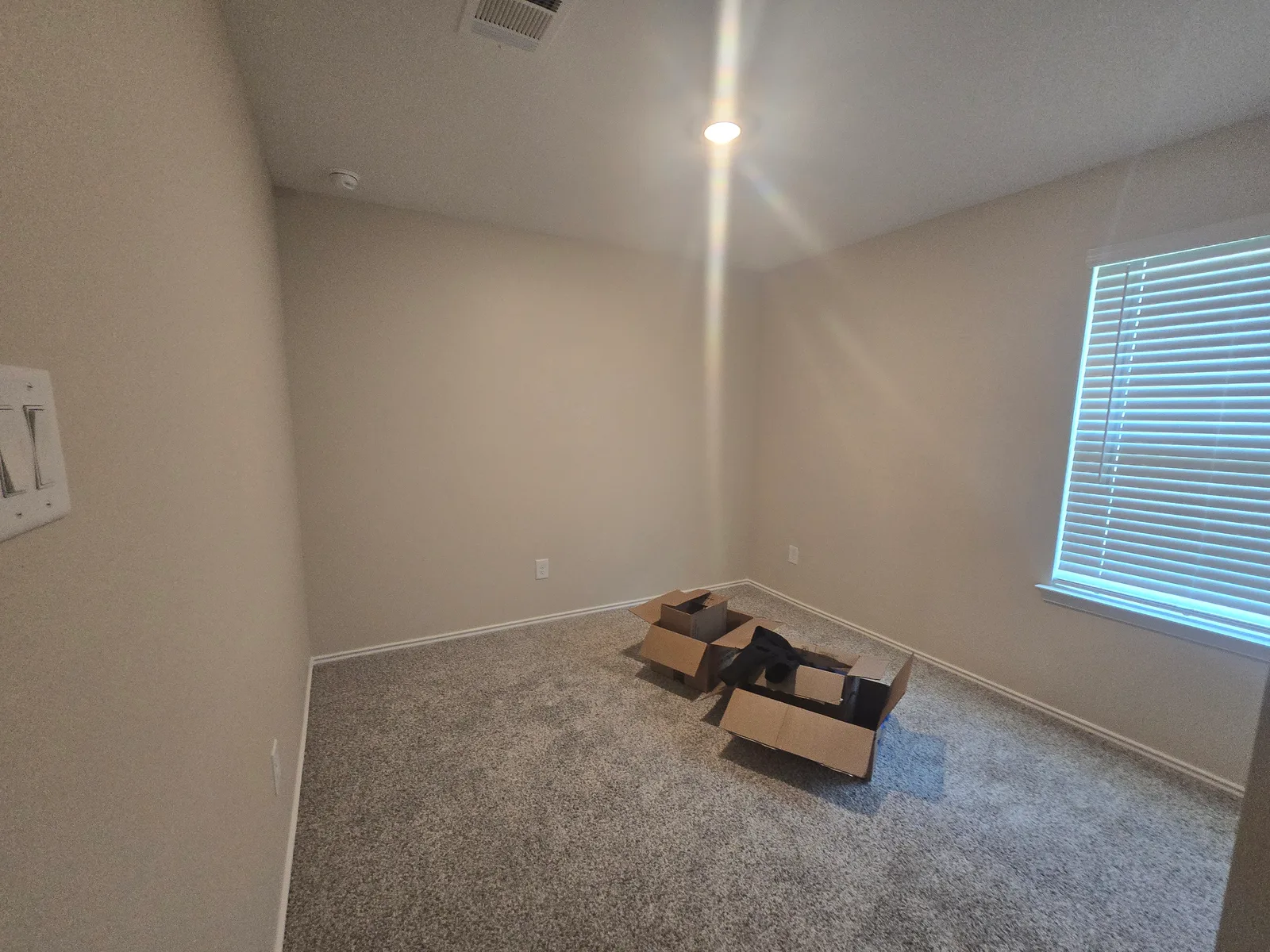
Most Fulshear homeowners don't know they'll want a repaint until a year or two in, and that's normal. If you're reading this before the last box is unpacked, that's the one timing advantage worth knowing about.
What does it cost in Fort Bend County?
We don't have enough closed jobs specifically in Fulshear yet to publish a formal city-level average, so rather than guess at one, here's what we can tell you straight: our published rates, and what those rates actually add up to on a typical Fulshear new-construction home.
| Surface | Rate |
|---|---|
| Walls | $2.00 / sq ft |
| Ceilings | $1.20 / sq ft |
| Baseboards | $1.92 / linear ft |
| Doors | $96 each |
| Windows | $54 each |
| Primer (when needed) | $1.00 / sq ft |
These are the same rates we use to build every interior walkthrough quote, published in full on our interior painting prices page. The primer line is the one worth watching for a settling-related repaint: any wall patched for a nail pop or a hairline crack gets primed over that patch before the topcoat goes on, so a house with more settling repair carries more primer line items than a straightforward color refresh.
What does that look like for a typical Fulshear home?
For a typical four-bedroom new-construction home in Cross Creek Ranch, Jordan Ranch, or Polo Ranch, those rates generally land in two places depending on scope:
Walls only: starting around $7,000. This is what we usually recommend for a newer build — walls do almost all the visible wear, and in a two-to-four-year-old house the ceilings and trim are usually still in good enough shape to leave alone.
Walls, ceilings, and trim together: starting around $10,000. This makes sense if you're changing colors throughout — our color consultation service is built for exactly that decision — dealing with more settling-related repair, or want everything refreshed in one pass.
Those are starting points for a typical four-bedroom floor plan, not a ceiling on the range — a larger home, heavier repair, or more colors will push the number up. The most accurate number for your house still comes from someone walking it in person, and our guide to defining your painting budget is a good place to start before that conversation.
What should you do next?
Walk your house in daylight, not lamp light, starting with the hallways and stairwells — they take the hardest wear and show the first honest signs. Check where touch-ups have been tried and whether they still blend, then look at the baseboards and kids' rooms, which tend to lead the rest of the house by six months to a year.
If what you find lines up with the signs above, it's worth getting an honest opinion rather than guessing. We walk homes across Cross Creek Ranch, Jordan Ranch, and Polo Ranch every month that sit somewhere on this exact timeline — you can see examples of that work in our project portfolio. Our interior painting in Fulshear work is built around getting that timing right, not just showing up with paint.
Frequently Asked Questions
Is two years too soon to repaint a new construction home?
Not necessarily. Two years is often when the first real signs show up — nail pops, faded touch-ups, worn hallways — once the house has mostly finished settling. It's too soon only if you repaint before any signs appear.
Will my new house keep cracking after I repaint?
Most structural settling that causes nail pops and hairline cracks slows down by year two to three. Repainting after that point, rather than in the first year, avoids paying to patch and repaint the same crack twice.
Can I just touch up instead of repainting the whole room?
You can, until the touch-ups stop blending. Flat builder paint fades unevenly and can't be spot-matched forever. Once a touch-up reads as a different sheen or shade, the room needs a full repaint.
Do you have Fulshear-specific pricing?
Not a formal city-level average — we haven't closed enough Fulshear jobs yet to publish one honestly. What we can tell you is that a typical four-bedroom new-construction repaint in Fulshear starts around $7,000 for walls only, or around $10,000 for walls, ceilings, and trim together. An in-home estimate is still the only way to get a number specific to your house.
Is it cheaper to repaint before or after moving in?
If you already know a repaint is coming within the first year, doing it before move-in is the more efficient version of the same job, since there's no furniture to move or protect. It's not required, but it's the lower-effort path if the timing works for you.
If your Fulshear home is somewhere on this timeline, we'd rather walk it with you and tell you honestly than guess over the phone. Request a free in-home estimate and we'll look at your walls, baseboards, and hallways together and tell you exactly where your house stands.